


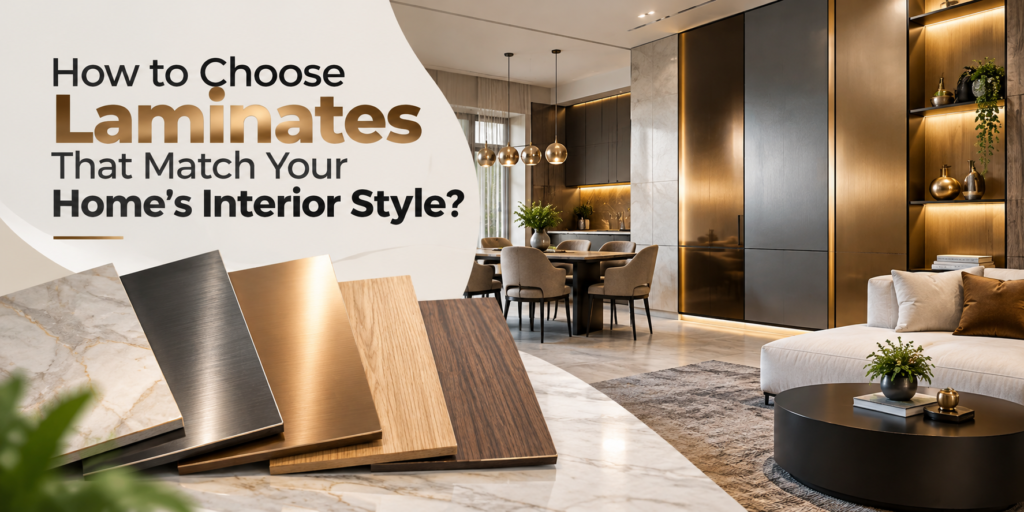
How to Choose Laminates That Match Your Home’s Interior Style?
A sample chip that looked like soft oak under the showroom’s white tubes can turn yellowish beside cream floor tiles, or look flat against a wall you painted sage green last year. It happens often, and it is rarely the laminate’s fault. A laminate is judged by what surrounds it: the floor, the walls, the light from your windows and the furniture it will stand next to.
Choosing one is therefore less about picking a favourite colour and more about fitting a finish to the home’s style, the light in each room and the job the surface has to do. This guide goes through that in order, with the Riddhi Siddhi Laminates range in mind where it helps.
1. Understand Your Home’s Interior Style First
Look at what already repeats in your home: straight lines or curves, plain or patterned surfaces, warm or cool metal in handles and light fittings. That repetition is your style, whatever name you give it.
- Contemporary: clean lines and mixed materials. Solid colours and wood grains work, with one glossy or textured accent.
- Minimalist: few objects and quiet colours. Plain whites, soft greys and neutrals let furniture recede.
- Traditional: panelled or carved furniture and warm tones. Medium to deep wood-inspired shades suit it.
- Modern luxury: reflective surfaces, marble-look finishes and metallic details, usually against a darker or high-contrast backdrop.
- Nature-inspired: timber grains, earthy greens and clay tones, and textured surfaces.
These are starting points, not rules. Many homes sit between two styles, and that is fine.
2. Choose Colours That Complement What You Already Have
Start from the surfaces you cannot change easily. If your floor tiles are cream or ivory, a warm wood shade or a beige laminate will sit comfortably, while a grey-toned one may look cold beside them. With grey flooring and white walls, a cool light oak or an ash tone tends to look consistent, and a darker wood on one unit adds depth.
Light shades make a room feel more open because they reflect more daylight. Darker finishes create contrast, so they work best on one element, such as a TV unit against a pale wall, rather than on every shutter.
Curtains and upholstery give you a shortcut. Pick one colour from the sofa fabric, say a muted teal, and repeat it in a single shutter or a shelf back. Lay each sample against white paper, then against the floor, to judge whether its undertone is warm or cool.
3. Select a Finish That Suits Your Design Preference
Finish changes how a colour reads. A grey in matt and the same grey in gloss feel like different materials.
- Wood-inspired finishes suit warm, natural interiors, and they are forgiving in family homes.
- Stone-textured finishes add visual depth to feature panels. Confirm what is currently available in the E-Catalogue rather than assuming.
- Marble-look and gloss finishes suit selected furniture such as a crockery unit or a console. The website describes its Imperial Mica as a marble finish gloss mica, which is worth reading if you are comparing Marble Finish Gloss Mica Manufacturers.
- Metallic finishes work best as accents: a niche back, a shutter strip, a small display unit. If you are researching Metallic Mica Manufacturers, ask for current shade options and see them in person.
- Glitter finishes give a subtle highlight in a small area, such as one dressing-unit panel. Riddhi Siddhi Laminates names Glitter Mica Manufacturers in its homepage description, so it is a fair question to raise when you request the catalogue.
4. Match Laminates to Different Rooms in Your Home
Living room. Treat the TV unit as the anchor. A wood-inspired finish with one darker or glossy panel beside it keeps the screen from competing with the surface. Display cabinets and shelves look tidier in one calm shade, so the objects on them do the talking.
Bedroom. Wardrobes are the largest surface, so keep them restful: soft neutrals or light woods. Use a deeper shade or textured finish on the headboard wall or bedside units. Check how the shutters look under the bedside lamp, since that is when you see them most.
Kitchen. Plan colour coordination with the counter and backsplash first. Confirm that the chosen product suits its intended use and ask for cleaning advice, as glossy shutters show fingerprints and grease quickly. Matt or lightly textured shades near the hob are easier to live with.
Study room and home office. Light, low-contrast finishes keep a work area visually organised. A single darker shade on a bookshelf or storage unit gives structure without crowding the desk.
Small spaces. Light colours and a small number of finishes make a compact room feel larger. A glossy shutter reflects light, but a whole wall of it can look busy, so keep it to a few doors. Matching the wardrobe to the wall colour makes it blend in rather than dominate.
5. Combine Different Laminates Without Making the Room Look Busy
Pick one dominant finish, and let a second one play the accent. In a living room, wood-inspired laminate on the TV unit and shelves can carry most of the look, with a stone-textured or metallic strip as the single accent. Neutral shades between them give the eye a rest.
Trouble starts when two surfaces compete. Marble-look gloss beside a metallic panel beside a heavy wood grain gives the eye nowhere to settle. A simple test: if you cannot say which finish is the main one and which is the accent, remove one.
6. Consider Lighting Before Finalising Your Choice
Light changes colour more than most people expect. Daylight brings out true tones, warm bulbs add yellow and make beige shades richer, and cool white LEDs can flatten wood tones and make grey look harder. A north-facing room usually gets cooler, softer light, so warm finishes help. A west-facing room can look strongly golden in the evening.
Take physical samples home. Stand them upright, at the height they will be fixed, and check them in the morning, in the afternoon and under your evening lights. Reflective finishes need this most, because they show every light source in the room.
7. Check Thickness, Intended Application and Maintenance
Ask for the specifications before you pay. The website lists its 0.7mm range (Neo Lam, Nepal Lam, Nepal Lam Fabric, Nepal Lam Fabric Non Brand, Real Mica and Shark Mica) and its 0.8mm range (Mirror Mica and Imperial Mica). When comparing 0.7mm Laminates Manufacturers and 0.8mm Laminates Manufacturers, ask which thickness suits the furniture and the board your carpenter plans to use. Neither is automatically right for every job.
Product pages also carry technical specification tables that refer to IS 2046 properties, and some offer downloadable catalogues. Whichever Mica Sheet Manufacturers you buy from, ask about installation requirements and cleaning advice for the exact product, and ask your carpenter how the edges and joints will be finished.
8. Common Mistakes to Avoid When Choosing Laminates
- Choosing a finish without looking at the floor, walls and curtains.
- Trusting showroom lighting instead of your own rooms.
- Mixing too many patterns, textures and glossy surfaces.
- Forgetting how often a surface will be touched and cleaned.
- Skipping the specification check, especially thickness and intended use.
Choose Laminates That Feel Right for Your Home
The best laminate is the one that agrees with the rest of the room: its style, its colours, its light and the way the surface will be used. Decide the style first, narrow the colours using what you already own, pick a finish with a clear role, and test samples at home before ordering.